
The Revelation of Dionne Daphne Review: What It Costs to Carry Trauma in Silence
Mara Brock Akil's debut novel asks what healing actually looks like when the past won't stay buried. (Spoilers maybe evident in this review)
The Revelation of Dionne Daphne opens with a knock on the door. Dionne, a beauty editor with the career and the social circuit that make her look like she has it all answers expecting reconciliation with her ex, Darren. Instead, he delivers news that could threaten her life: she may have been exposed to HIV. That single moment cracks open everything she's spent years keeping sealed shut, sending her on a spur-of-the-moment road trip with Dominic, an unlikely stranger, to confront the family and the childhood secrets she's never let anyone see.
The Weight We Carry Into Our Relationships
What struck me most reading this wasn't the plot mechanics, it was how honestly the book portrays trauma living in the body. Dionne's overthinking, her sudden outbursts, the way she'd flare up and then a page later come back to her senses , at times it read as frustrating, almost erratic. But it also felt real. There are people who move through the world exactly like this, and I've never been in her shoes, so I try to hold space for that. The book is really a study in how humans walk around carrying trauma into our everyday interactions, often taking it out on the people least responsible for it.
That dynamic plays out most clearly with Dominic. There was no real reason for Dionne to go off at him in certain moments — he was, in the most literal sense, just trying to help her. But when you've carried something for as long as she has, the triggers and the emotional complexity can overwhelm even good intentions. Still, it felt unfair of her not to expect Dominic to be upset once she flipped on him, or to expect him to stay open after that. This also brought to mind Men We Reaped by Jesmyn Ward both books sit with how the men in a story (Dominic, the stepdad, her father) are shaped by culture, church, and the generational patterns handed down through grandparents and parents alike.
Judgment, Classism, and the Cost of "Having It All"
The novel also quietly indicts American classism, the idea that wealth becomes the measure of identity, and that we're all conditioned to chase it, especially within capitalism. It's a culture rooted in slavery and patriarchy, and those threads run through the fabric of the story even though it's set decades in the past. Sitting with that made clear how little distance we've actually traveled.
And yet, I found myself pushing back on Dionne in places too. There's an unfairness in placing judgment on people who are moving through their own risk and pain differently than we are something Dionne does, especially toward Dominic. I had a soft spot for him. She stayed guarded around him because of the labels tied to his past, while engaging in her own reckless behavior. Different levels of risk don't earn anyone the right to judge someone else's.
Two Lines Worth Sitting With
"Confronting your past isn't a disruption of your life. It is healing that begins with you and extends to those around you who also need healing."
"Just like you can absorb pain, you can also absorb love."
The Verdict: 3.75–4 out of 5
You can tell this book was written by Mara Brock Akil — the prose, the description, the attention to detail all carry her signature. Where it stumbles is the ending, which lands more like a cliffhanger than a resolution. What happens with Dionne and Dominic? Is the stepfather ever held accountable? What became of his marriage, the house? And the reveal that the stepmother worked at the same magazine deserved its own conversation that never quite arrives. A lot of threads get opened and never fully closed which, if you've watched Akil's TV work, will feel familiar rather than surprising.
Still, this is a book about what it costs to hold trauma alone, and what becomes possible when you stop. Worth the read and if you're an audiobook person, DeWanda Wise narrates it, which is reason enough on its own.
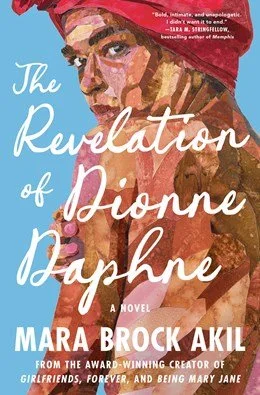
NATIONAL BESTSELLER • Amazon Editors' Pick - Best Literature & Fiction of July
Mara Brock Akil, the award-winning creator of Girlfriends, Being Mary Jane, Love Is, and Forever, pens an emotionally enthralling debut novel about enduring love, world-shattering secrets, and self-awakening.
What happens when one knock at your door sends your entire world into chaos? When a stranger becomes a lifeline? When the reality you’ve meticulously curated seems to be a mirage?
From the outside looking in, one might say that Dionne Daphne had it all: being the beauty editor at a prestigious New York magazine, a boyfriend who could have been plucked out of its model pages, the social life of the upper echelon, and a girlhood steeped in debutant balls.
But that is from the outside. When the now ex-boyfriend arrives at her Brooklyn doorstep Dionne imagines reconciliation, going back to the good life brimming with the possibility of marriage; the life her mother always wanted for her. Instead, he delivers life-threatening news that creates a crack in her picture-perfect world. A crack that grows legs and runs her right into her past, unearthing a secret that she has hidden since childhood.
In an effort to run toward the truth and away from a lie, Dionne sets out on a spur of the moment road trip with an unlikely stranger to confront the long-buried darkness of her past and the family who made it so. As Dionne comes to a final reckoning, she begins to unravel new layers of herself and fresh possibilities for her life, her family, and even her love.
The Revelation of Dionne Daphne is at once a deeply moving and provocatively gripping novel that shows when you dig deep enough into the shadows of your life, light can be revealed. It’s a novel of broken lovers, a fractured family, and distant friendships all making their way back to one another.
Story Locale:New York City, 90s
